


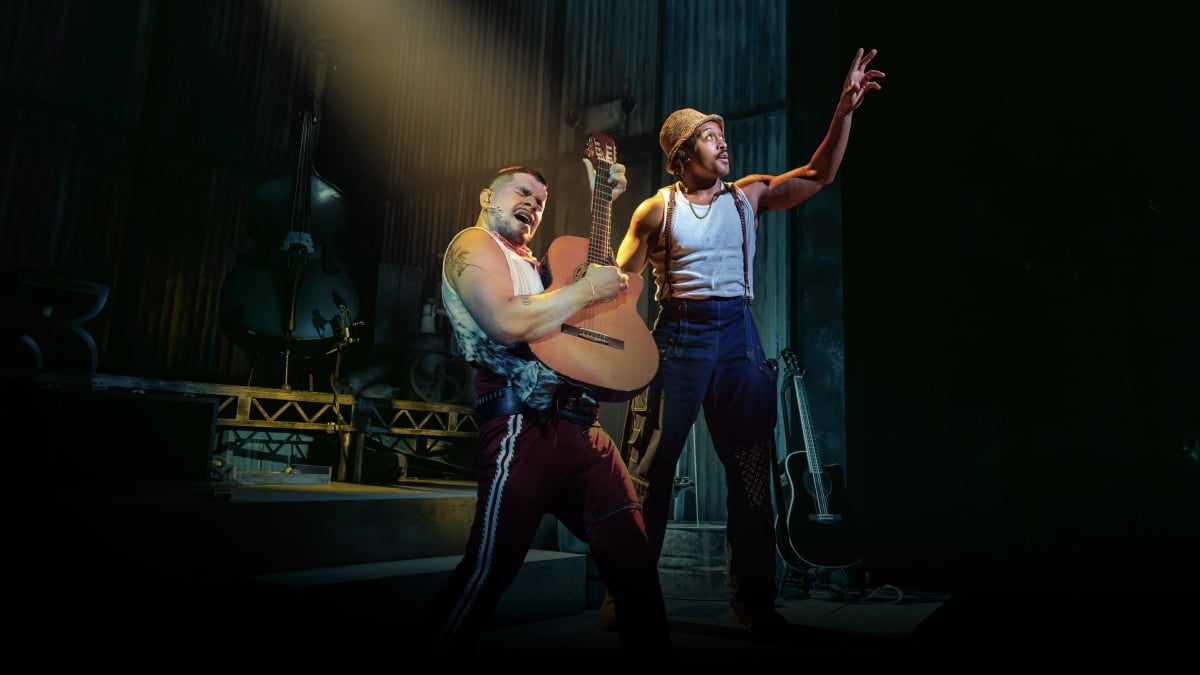
I can’t count the number of times my jaw dropped while watching Mexodus.
Much of that wonder comes down to the show’s live looping, which sees creators and performers Brian Quijada and Nygel D. Robinson creating the show’s score from scratch onstage. But there’s more goodness where that came from, as Quijada and Robinson interrogate under-taught history through powerful personal storytelling and hip-hop. Separately, these elements would be fascinating enough. Combine them, and the results are electrifying.
Mexodus tells a lesser-known tale of the Underground Railroad.

Brian Quijada and Nygel D. Robinson in “Mexodus.”
Credit: Thomas Mundell
If you hear the phrase “the Underground Railroad,” chances are you think of the network of routes slaves in the American South took north to escape bondage. Yet as Quijada and Robinson tell us, there was also a southbound network that brought thousands of slaves to freedom in Mexico. How many thousands? We don’t know for sure, Quijada and Robinson say, in one of the many moments when they speak to the audience themselves. The story of the southbound Underground Railroad is not a story you’ll find in many history books, but it’s one the duo hopes to pass on through word of mouth, with Mexodus‘ story serving as a composite of their own research.
Robinson plays Henry, an escaped slave who evades capture in Texas and barely survives a dangerous crossing of the Rio Grande. He’s saved by Quijada’s Carlos, a medic-turned-farmer battling his own demons from the Mexican-American war. Wary of each other at first, the two soon grow to overlook their differences, collaborate on Carlos’s farm, and even become firm friends.
Mashable Top Stories
Mexodus‘ live looping will have you hooked.

Brian Quijada and Nygel D. Robinson in “Mexodus.”
Credit: Thomas Mundell
Quijada and Robinson build the soundtrack to Carlos and Henry’s friendship in real time, looping and layering their own vocals and instruments. A lot of the instruments are recognizable: pianos, cellos, trumpets, guitars, drums, vinyl scratching. That Quijada and Robinson are playing all of them and rapping at superhuman speed and harmonizing with themselves is already impressive enough. But what kicks Mexodus into an even higher gear is when Quijada and Robinson interact with the stage itself, designed by Riw Rakkulchon. Corrugated walls become sources of percussion and even thunder. A wooden wheel modulates tracks’ tempos. Pedals around the stage loop the sounds, and watching Quijada and Robinson stomp on them to control the next loop is a magic trick that never gets old.
Another magic trick? The live looping doesn’t end with Mexodus‘ songs. Quijada and Robinson craft soundscapes too, from storms to crackling fires. My personal favorite moment came when Quijada strummed a comb to create the sound of chirping insects coming out at night. Yes, we fully see what causes the sound effect — in fact, we see what causes every sound in the show — but as Mikhail Fiksel’s sound design amplifies it throughout the theater, it becomes something new. The theatrical experience allows us to leap from the mundanity of the comb to the fantasy of the bugs it’s imitating.
There’s a communal aspect to the live looping as well. Quijada and Robinson feed off our joy at each aural surprise. (Quijada took a smiling bow after my audience oohed at how he created the sound of fire.) They also take several opportunities throughout the show to step outside the story and tell personal tales: Robinson of his ancestors, Quijada of a time when he witnessed the same kind of prejudice and division that would have alienated Carlos and Henry centuries ago. Each moment builds on Quijada and Robinson’s reminders that it’s up to us to pass down the unknown stories of the Underground Railroad that led south, culminating in a goosebump-inducing moment of audience participation.
By inviting the audience into their stories and showing us how each song is created, Quijada and Robinson have created a riveting, joyful take on an unsung chapter of American history. It’s one that I guarantee you won’t forget.