


Anyone who’s seen Netflix’s award-winning series Adolescence will have heard the word “manosphere” — and most people using the internet in recent years will have encountered it.
The term refers to an online subculture in which so called “alpha males” — think Andrew Tate and the like — preach a life philosophy that espouses traditional, outdated, misogynistic versions of masculinity like dominance, emotional stoicism and the subjugation of women.
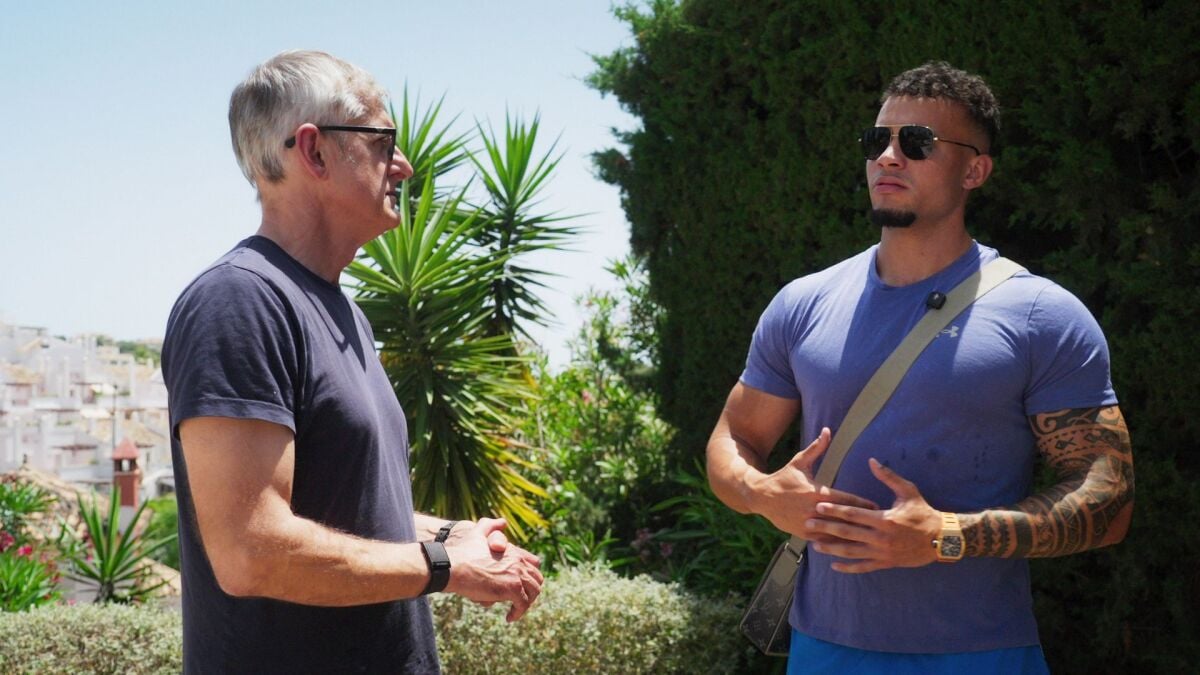
In Louis Theroux: Inside the Manosphere, the legendary documentary-maker submerges himself in this murky world, spending time with influencers while trying to get to the bottom of where their world view comes from.
The question is, how successful is he?
What’s Louis Theroux: Inside the Manosphere about?
“I coach boys how to be fucking boys. How to make money, how to be outside the system, how to not have a boss telling you what to do. I teach guys to be proper guys.”
This is how Harrison Sullivan (known online as HS Tikky Tokky) responds when Theroux ask him what his core message is. The remainder of the feature-length documentary essentially unpacks this sentiment, examining how influencers like Sullivan come to hold their views, how they make their money, and the type of impact their content has on the fans that consume it.
To do this, Theroux spends time with Sullivan and a number of similar influencers, jumping between livestreamed nights out in Spain and tours of flashy apartments in Miami. He speaks to a friend of the Tate brothers, Justin Waller, and the host of controversial Fresh and Fit podcast, Myron Gaines, both of whom espouse a “one-way monogamy” in which they’re allowed to sleep with other people while their partners can’t. Theroux also spends time with formerly banned YouTuber Sneako, who’s morphed from the manosphere to far-right politics and pushing conspiracy theories.
“If I’d just done good things, I would never have really blown up on social media in the first place.”
Theroux’s interviews expose a number of similarities between the influencers he meets: They all share extreme views, they’re anti-feminist, and — crucially — they’ve all found a way to profit from sharing these views online.
Inside the Manosphere exposes the contradictions, and the money
With half a million people in his Telegram group, Sullivan is able to drive fans towards the profiles of OnlyFans creators and financial apps, both of which provide him with a revenue source. Throughout the documentary, though, his disdain for OnlyFans creators is clear. When Theroux asks him if it’s a contradiction to be profiting from OnlyFans creators while also denigrating them, Sullivan is unapologetic.
Mashable Top Stories
“I openly say I don’t give a fuck, and I’m doing it for money,” he says.
Gaines’ relationship with OnlyFans creators is shown as similar; he frequently has them as guests on his podcast, while also doing his best to publicly humiliate them.
Waller, meanwhile, has a similar business model to Sullivan’s financial apps. As we see in the film, he promotes subscriptions to a self-described “online university” created by the Tate brothers called The Real World, where people pay $49 a month for access — and Waller gets a cut.

Justin Waller is one of several prominent manosphere influencers that Theroux interviews.
Credit: Netflix
The documentary makes it clear that while these various influencers may hold the views that they preach, their primary motivation is financial — and Sullivan in particular says he’s happy to make money even if the means goes against his own philosophy.
“Why not try and be a good person?” Theroux asks him at one point, in one of the documentary’s most interesting exchanges. “Why not try and uplift people, rather than pandering to their worst impulses?”
Sullivan seems to genuinely spend a moment thinking about it. “It’s a good question,” he says eventually. “If I’d just done good things, I would never have really blown up on social media in the first place.”
Is there a danger of giving these people a bigger platform?
Manosphere influencers aren’t the first controversial group that Louis Theroux has spent time with. He’s previously made shows on the homophobic Westerboro Baptist Church, and in 2022 he made a programme in which he spent time with far-right influencer Nick Fuentes. There’s sometimes a tension in his work when it comes to featuring figures like this: Does giving them air time actually raise their profiles, and therefore their influence? Is it possible that in spending time with them, Theroux is doing more harm than good?
This is a question that comes up in the documentary itself, in Theroux’s final meeting with Sullivan and his mother, Elaine. She puts it to the documentarian directly: “If you don’t agree with what Harrison is doing, then why are you making money off of it on a program by publicising it?”
She may have a point. But in the case of the manosphere, you could also argue that the problem is already out there. And even if Theroux’s documentary risks giving Sullivan more attention, it also does a solid job of exposing what he and his peers are really about: profiting from their followers.
Rather than coming across as some kind of revolutionary philosophy that will help uplift struggling young men, the manosphere depicted in Theroux’s documentary seems more like a multi-level marketing scheme. Influencers portray themselves as having made it so they can build a following, which then allows them to monetise the people they claim they’re trying to help.
Louis Theroux: Inside the Manosphere is streaming now on Netflix.