


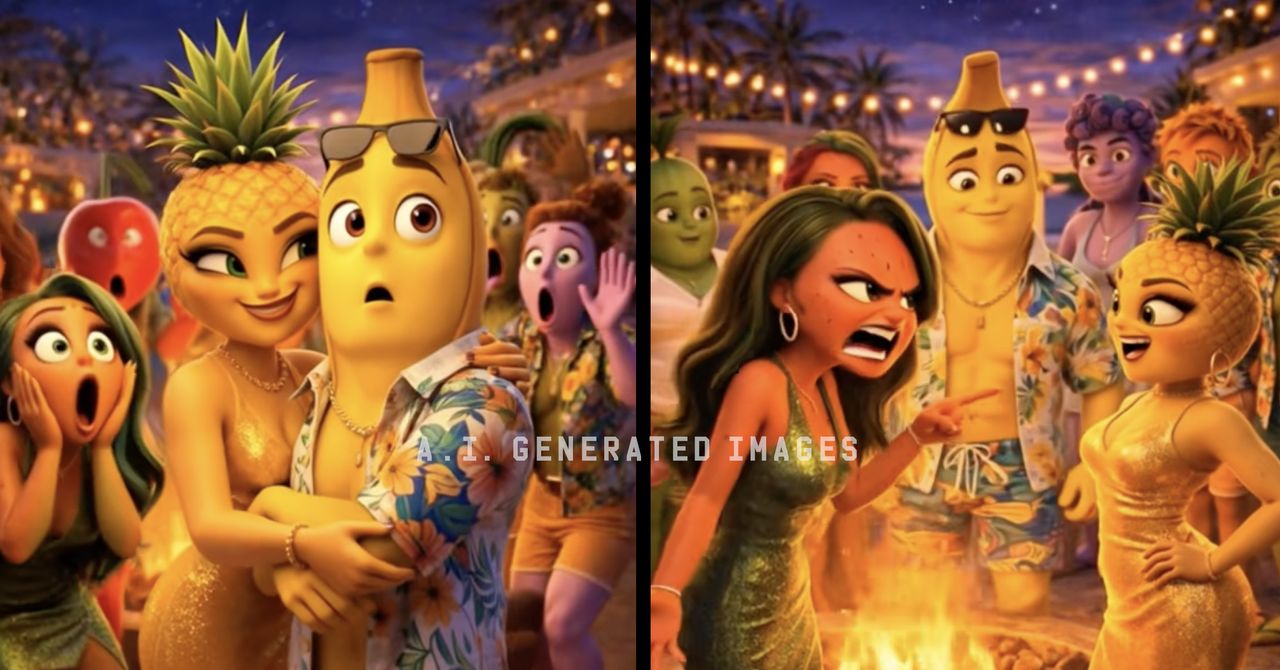
“I’ve spent a lot of time looking at the comment sections on these videos actually, and it does not seem like bots. I clicked on people’s profiles; these are real profiles, thousands of followers, no signs of inorganic activity,” Maddox says. “People just like it.”
But even if the views and engagement are real, that doesn’t mean this content is profitable—yet. Maddox noted that because the accounts are so new, most likely aren’t yet enrolled in TikTok’s Creator Fund or other forms of social media ad revenue-sharing, because those usually require accounts to apply and have a certain number of views. But, Maddox says, the earning potential is huge, with the ability to earn thousands of dollars per video if they get millions of views.
AI fruit content started getting posted earlier in March, before Fruit Love Island, but many of the recently created pages clearly take inspiration from its success. There’s The Summer I Turned Fruity, based on the popular teen drama The Summer I Turned Pretty; The Fruitpire Diaries, based on the CW series The Vampire Diaries; and Food Is Blind, based on Netflix’s Love Is Blind.
Predecessors of this AI fruit content include the Italian brainrot characters like Ballerina Cappuccina and Bombardino Crocodilo and the Elsagate controversy. But with these AI fruit miniseries that attempt to follow a narrative across multiple segments or episodes, the clearest parallel actually feels like microdramas, vertical short-form scripted series that American big tech companies are starting to invest more in. Like the AI fruits, these are minutes-long episodic shows intended to perform well on social media, eventually directing viewers to paywalled sequels.
Ben L. Cohen, an actor in Los Angeles who is credited in around 15 of these vertical microdramas, sees at least one common thread between the AI fruit dramas and the shows he has worked on: They both feature “lots of violence toward women.” They also try to cram as much drama as possible into these short clips and have attention-grabbing titles in the style of “Alpha Werewolf Daddy Impregnated Me,” Cohen says.
“It draws people in, I think, seeing that jarring, absurd, cartoonish vibe. It’s cartoonish abuse, but it’s still abuse.”
Vertical microdrama acting work still exists in LA, which can’t be said for all acting gigs right now. Cohen has had conversations with other people working in the industry about how AI is already being integrated more into the videos, potentially posing a threat to the existence of human actors in clickbait content. After all, it’s much cheaper and faster to churn out AI fruit episodes than actual productions. It also raises the question—are some people going to prefer the AI series over the ones they’re inspired by? Already, the answer is yes.
“How is Love Island gonna outdo AI Fruit Love Island?” asked a TikToker with more than 70,000 followers, arguing that the AI fruit version was more engaging than the actual reality show. She deleted the video after it started getting backlash, but other people agreed with her.
“I think TikTok was definitely a big part of that,” Cohen says about the audience’s shortening attention span and desire for compressed, sometimes AI-generated drama. “It makes sense that people are intrigued by a one-minute clip, and then they’ll be like ‘Oh, I’ll watch another one-minute clip.’ You’re not committing to a full, heaven forbid, 20-minute episode. Or 40 minutes. Or an hour. You can just watch one minute.”